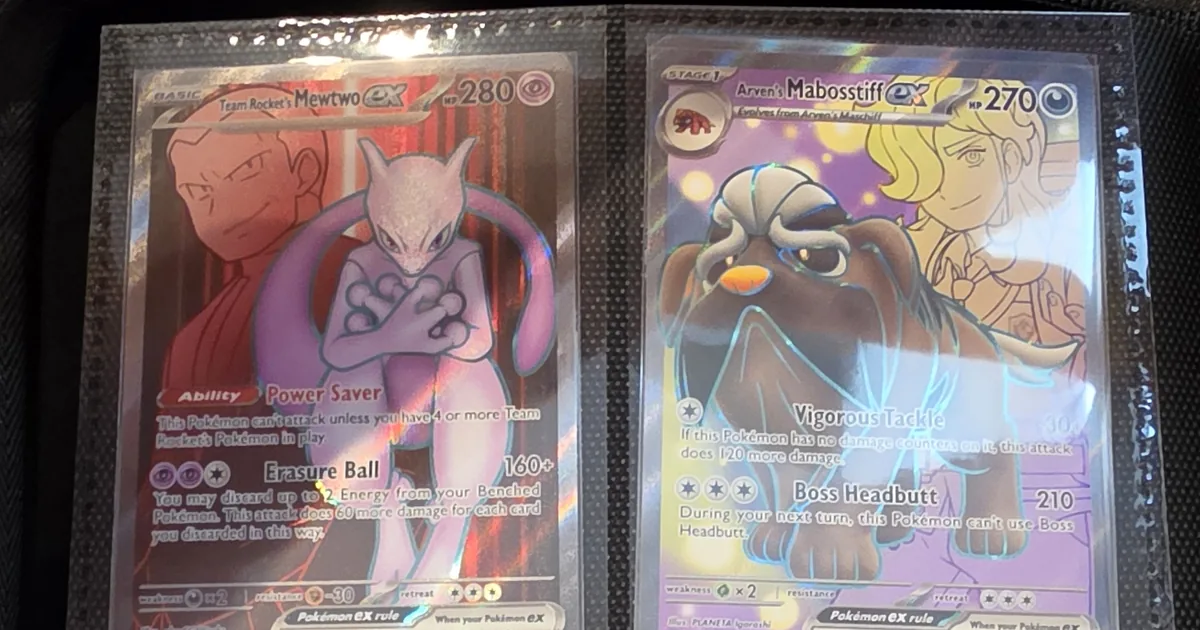
Pokémon card value: how to check what your cards are worth
How to check what your Pokémon cards are worth in euro, using the Cardmarket prices Irish shops and buyers use, and what condition and bulk do to the number.
"How much is this worth?" is the question we hear most at the counter, usually with a phone held out showing an eBay listing for €400. The card is almost never worth €400. Here is how to get a real number, the way we do it in the shop.
Market price is not asking price
Anyone can list a card on eBay for any price. A listing is what the seller hopes for, not what anyone paid. A card can sit at €400 for a year with no buyers while the same card sells every week for €40.
To see what people actually pay, you need sold prices. On eBay, tick "Sold items" in the filters and ignore everything else. Better again, use Cardmarket, which is where most Irish card buyers and shops get their prices, and where our own quote tool gets its numbers. Cardmarket is in euro, so there is no converting from dollar prices on American sites, which run on a different market and often come out higher or lower than what a card fetches here.
Looking a card up on Cardmarket
You need three things from the card itself.
The card number. It is in the bottom corner, written like 213/182. The second number is the size of the set, and secret rares go past it, so 213/182 is normal. Type the Pokémon's name and that number into Cardmarket's search and you will usually land on the right card straight away.
The set. Older cards show a small set symbol beside the number. Newer cards print a three-letter code next to it, like DRI or PAF. Two cards can share a name and even a number across different sets, so check this before you believe a price. A reprint from 2023 can be a fraction of the 2016 original, or the other way round.
The version. Holo, reverse holo and plain versions of the same card have the same number but different prices. A reverse holo has the shine on the background rather than the picture. Cardmarket lists them separately, so pick the one in your hand.
Once you are on the card's page, look at the price trend and the 30-day average rather than the lowest listing. The lowest price is usually one damaged copy or a seller in a hurry. The trend is what the card is really worth this month.
What condition does to the price
Every price you see on Cardmarket is for a Near Mint card unless it says otherwise. Near Mint means no whitening on the back edges, no scratches on the holo, no dents and no bends. Hold the card under a light and tilt it. Most cards that have been played with, carried in a pocket or kept loose in a shoebox are not Near Mint.
| Grade | What it looks like | What it does to the price |
|---|---|---|
| Near Mint | Looks fresh from the pack, maybe one tiny edge mark | Full price |
| Excellent | A little edge wear you have to look for | A bit less |
| Light Played | Visible whitening on the edges, light surface scratches | A good bit less, often a third off or more on holo cards |
| Played | Scuffed corners, scratched holo, maybe a small crease | Often half or less |
| Poor | Creased, bent, written on, water damage | Close to nothing, whatever the card is |
The drop is steepest on expensive cards. A €2 card is a €2 card either way. A €100 card with a crease might be €20.
Which cards are worth checking
You do not need to look up 2,000 cards. Pull out these and leave the rest in the box.
- Anything that shines. Holos, full arts, gold cards, rainbow cards, "illustration rare" cards with the picture spilling over the border.
- Cards with ex, V, VMAX, VSTAR, GX or EX after the name. Most are worth a euro or two, the popular ones are worth a lot more.
- A number higher than the set size, like 213/182. That is a secret rare.
- Old cards. Anything from 1999 to 2003, especially with a "1st Edition" stamp on the left under the picture, or a Base Set card with no shadow on the right of the picture box. These are the ones people find in the attic and ring us about.
- Promos, the ones with a black star and "PROMO" beside the number, from tins, boxes and events.
- Charizard, Pikachu, Umbreon, Mewtwo and the Eeveelutions. The same Pokémon that were popular in the playground are the ones people pay for now.
Commons and uncommons, the ones with a circle or a diamond beside the number, and basic energy cards, are bulk. Bulk is worth cents a card and is priced by the lot, not one at a time. There is nothing wrong with bulk, every collection has it, but do not spend an evening looking up 800 Rattatas.
One warning. If you bought a collection second hand, check the big cards against a real one. Fakes are lighter, the colours are a bit off, the text is slightly blurry, and the holo looks printed on rather than in the card. A fake Charizard is worth nothing, no matter what the eBay listing says.
Get a number in a minute
If you would rather not do all of that by hand, our Sell Your Cards tool does it for you. Type or paste your cards, one per line with the number from the bottom corner, up to 1,000 in one go, and it prices every one against that day's Cardmarket prices. English Pokémon cards for now. Add "rev" for a reverse holo and "lp" or "pl" if a card is played.
The quote shows you what we would pay: 70% of market value in store credit, or 55% in cash. Credit can be spent on anything in the shop, games included. The quote assumes every card is Near Mint, and we check condition together when you bring them in, so the number you see is close to the number you get. Graded cards and 1st Editions are priced in the shop, because they need a proper look.
If you want to sell elsewhere, the quote is still a free valuation. Our post on where to sell Pokémon cards in Ireland goes through every option and what each one costs you.
The short version
Use Cardmarket, not eBay listings. Match the number, the set and the version. Be honest about condition. Look up the shiny ones and the old ones, and treat the rest as bulk. Then get a quote, or bring them down to York Road and we will go through them with you. We all love the cards, so the chat is free.
One more thing. If a card comes back from the tool at serious money and it is in great shape, ask us about grading before you sell it. A card in a PSA 10 case can be worth a multiple of the raw price, and we are Ireland's only official PSA dealer, so we will tell you straight whether it is worth the fee. There is more on card grading here.
You May Also Like
Riftbound in Dublin: how to start playing
Riftbound is the League of Legends trading card game, and it has been on our Wednesday nights since May. If you know League, you will recognise the champions. I…
Where to play Magic: The Gathering in Dublin
Magic: The Gathering in Dublin has more going on than it looks from the outside. There are weekly nights on both sides of the city, a draft here in Dún Laoghair…